Product DesignDefense
We design rugged, regulation-ready systems that survive the lab and the field. From MIL-STD-461 to MIL-STD-810, we build defense tech that performs under pressure.



Defense products don’t get second chances. If it’s going into the field, it has to work the first time—and every time after that. That’s why we design for the worst-case scenario, not the best-case lab conditions.


Defense product design
This standard covers electromagnetic interference (EMI) and electromagnetic compatibility (EMC) for systems used in military environments. We’ve developed and validated embedded hardware that meets these requirements across signal lines, enclosures and power systems.
We partner with compliance labs to design for test success from the start rather than fixing issues after the fact.
We’ve delivered:
- Signal filtering and EMI suppression at the schematic level
- Power grounding and trace shielding for noise isolation
- Clean PCB layout to reduce rework during EMC testing
- Enclosure design with EMI gasketing and traceable I/O shielding
- Faster time-to-certification through pre-compliance tuning
This standard defines environmental engineering tests for military equipment. We design mechanical and embedded systems that hold up in real conditions and pass rigorous lab and field testing. Our work supports long-term durability and steady mission performance.
We support testing for:
- Shock and vibration
- Altitude and thermal cycling
- Enclosure sealing against sand, dust and humidity
- Water ingress testing for IP68 protection, including one meter immersion for 30 minutes
- Salt fog testing for corrosion resistance
- Material selection for high and low temperature tolerance
- Embedded systems ready for rugged deployment
We're an engineering firm delivering product development, hardware design and production for defense clients. Our active DDTC registration with the U.S. Department of State lets us contract directly with U.S. government and defense agencies and handle sensitive program information and documentation.
We keep defense work inside our own team, from design through build, so controlled information stays with the engineers doing the work.
We've delivered:
- Sealed enclosures and serialized components for defense hardware
- Controlled documentation and revision history for defense manufacturing
- Requirement flow-down to vendors and supply chain partners
- Signal routing and board-level security for sensitive applications
- Technical collaboration with compliance and procurement teams on defense programs
We're also registered with:
- DECCS (Defense Export Control and Compliance System): the State Department platform where we hold and manage our DDTC registration.
- SAM (sam.gov, System for Award Management): the federal prerequisite for contracting with any U.S. government or defense agency.
Clients rely on us to bring mechanical, electrical, firmware and compliance expertise into one team. This coordination improves quality and reduces project delays through tight validation and integrated test planning.
Our approach combines early collaboration, environmental testing and rugged validation to reduce test failures and support faster certification.
What that means:
- Internal validation and debug testing during early-stage builds
- Thermal and EMI assessments before lab submission
- Shared knowledge of form factor and system interactions
- Aligned mechanical, electrical and testing teams
- Fewer surprises and fewer delays
We conduct pre-qualification testing in-house using EMI shielding assessments, thermal cycling and vibration simulation. By identifying issues early and iterating quickly, we reduce the risk of expensive failures during formal lab testing.
We use:
- Thermal chambers, vibration rigs and light EMI test fixtures
- Readiness reviews for MIL-STD-461 and 810
- PCB tuning and enclosure refinements based on live data
- Custom fixtures to simulate real-world mechanical stress
- Engineering checkpoints that support clearer compliance outcomes
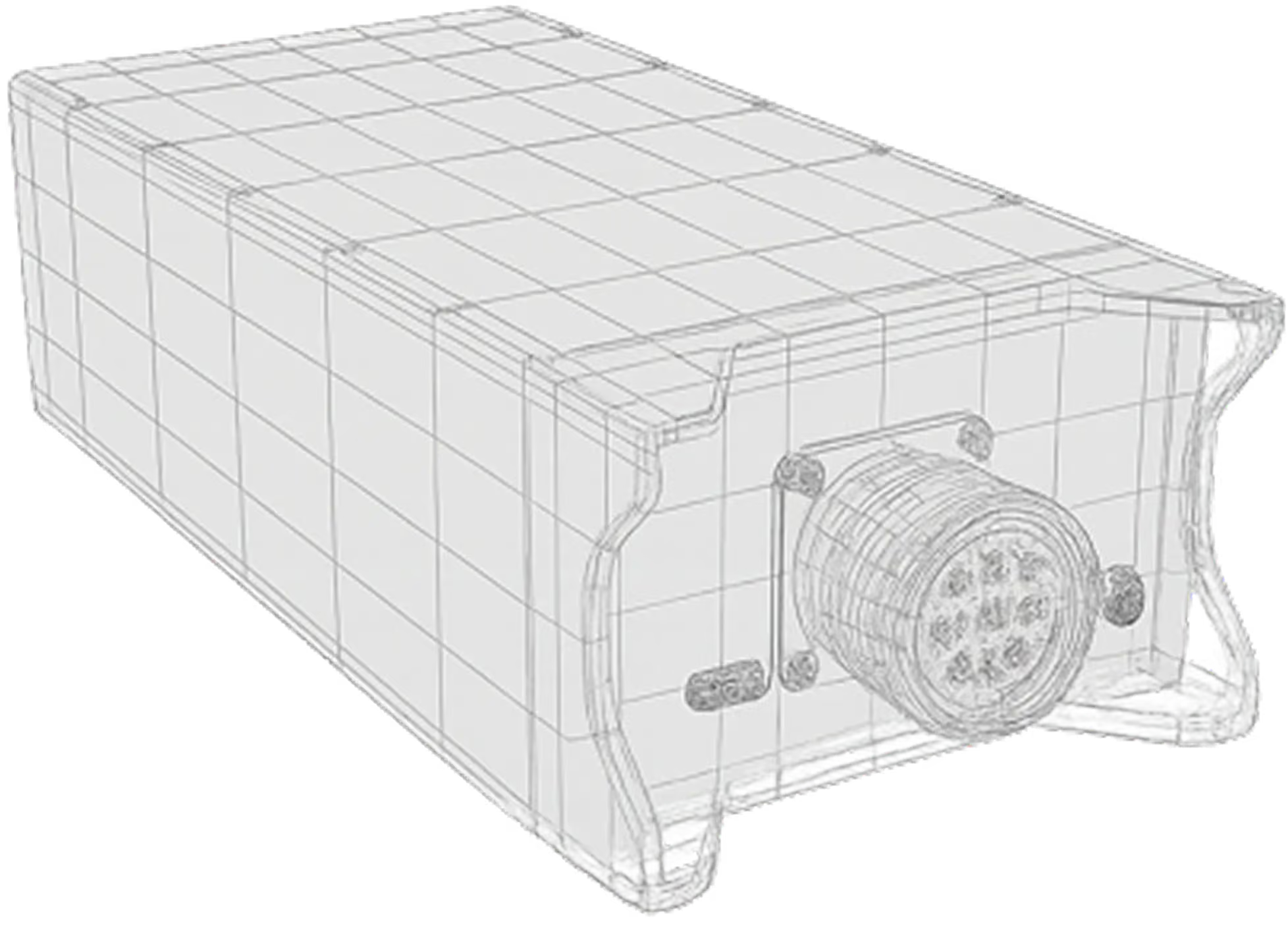
Designed for defense