
AI for the sky:A custom drone detection system
Developed for high-interference environments




Results that make a difference




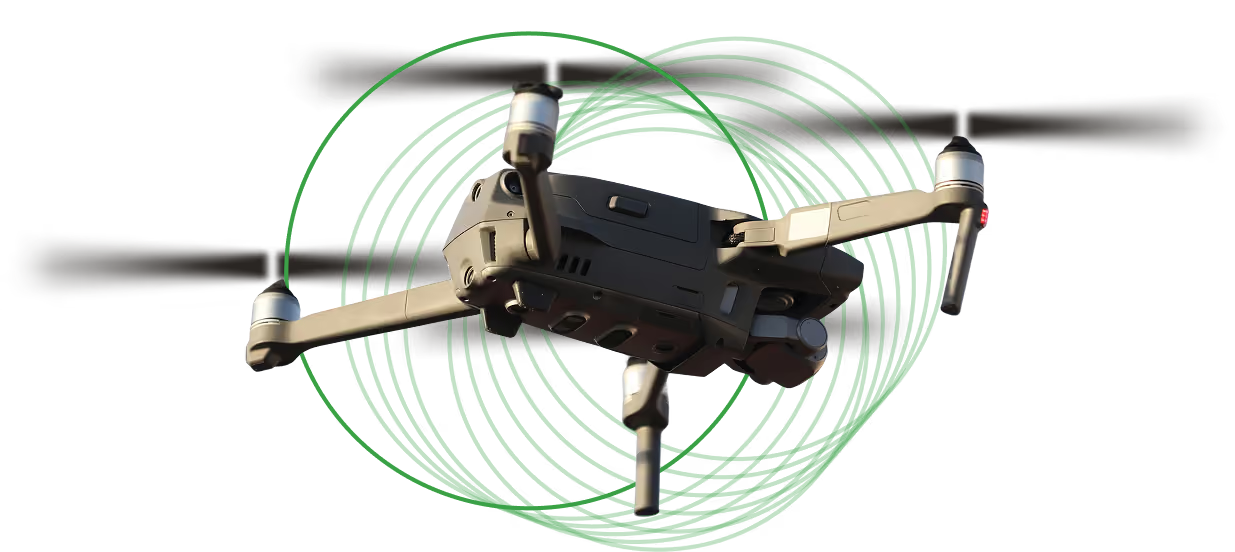
Drones are everywhere. In regulated airspace, at large public events and across defense and security operations, knowing what’s in the air has become a real operational challenge. And as drone technology gets smaller and cheaper, that challenge only grows.
Dillon Aero set out to build a detection system capable of operating across the full range of real-world conditions. In every environment, the requirement stays the same: detect drones reliably without broadcasting your own position.
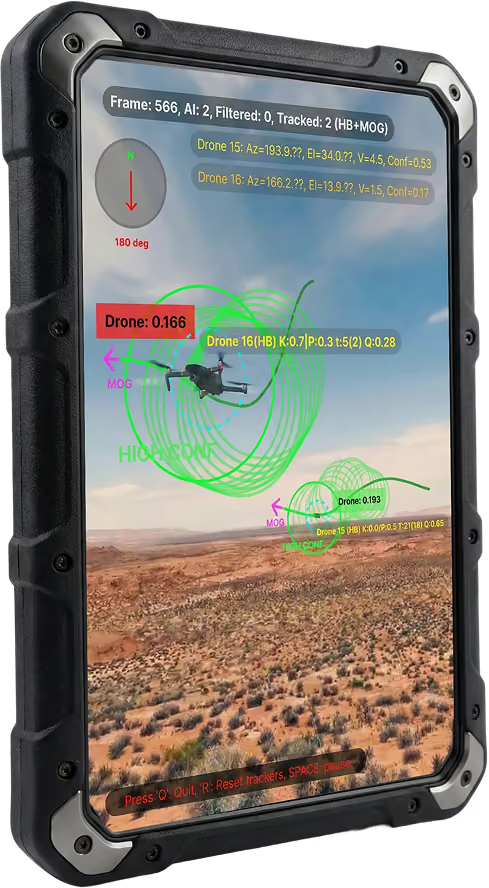
28 Gorilla trained custom AI models to develop a passive detection system, fusing radio frequency (RF) signal classification with computer vision to detect drones that single-sensor systems can’t.
An unsolved detection problem
Passive detection sounds straightforward until you account for everything working against it. RF signals from Wi-Fi networks, cellular towers and competing devices create constant interference that AI models can’t always filter out.
Visual detection is just as unpredictable. Lighting changes, background movement, birds and debris can all pull attention away from actual detections if the system isn’t built to tell the difference.
There’s a practical element, too. Dillon Aero needed a system that could operate across ground, maritime and airborne environments without a core redesign. Whatever the platform, the detection capability needed to come with it.
Test theory against reality
Most detection systems are built on existing tools and established methods. We started with something fresher. Academic research on RF signal classification, computer vision and applied AI pointed us toward approaches that hadn't made it into commercial products yet.
Then we stopped reading and started testing. We bought commercially available drone models and flew them in real conditions. Cloudy days, wind, open fields.
While lab conditions assume clean data and predictable inputs, the real world offers neither. We captured RF signals amid real interference and ran the footage through our models to see what actually worked. A lot of it didn't, and that was the point.
Staying close to what’s actually happening in the field changes what we build. Through our ongoing work with Dillon Aero, we tracked a significant development: some drones had stopped using wireless communication entirely, running fiber optic cables instead. A system that relies only on RF can’t detect them. That’s what made computer vision a hard requirement, not an add-on.
Because edge AI has to run on-device, there's no tolerance for AI that only works under ideal conditions. We test until the system performs reliably under the same noise, interference and variability it will face in the field.
Up close with
Skills & equipment used


- Defining RF signal quality and stability requirements for AI model performance
- Identifying and managing radio frequency interference sources including Wi-Fi, cellular and competing RF signals in complex environments


- Custom AI model training using real-world drone recordings across variable environmental conditions
- Computer vision detection using movement-based tracking algorithms capable of identifying drones from just a few pixels
- Passive RF signal classification built to filter Wi-Fi, cellular and competing radio frequency interference
- AI model validation using hand-marked frame comparison to measure azimuth and elevation accuracy
- False positive analysis and threshold refinement across multiple field recording cycles

- Translating academic and emerging research into deployable edge AI systems
- Defining AI and software performance requirements before hardware constraints exist
- Designing for multi-environment deployment across ground, maritime and airborne platforms from the start

- Designing edge AI systems for contested, unpredictable and electronically noisy operational conditions
- Building adaptive systems that operate across ground, maritime and airborne deployments without a core redesign